Somewhere between face creams that promise firmness and surgery that guarantees it sits a technology most people in Muscat have heard of but few can explain: MFU — micro-focused ultrasound. It’s the treatment behind most “non-surgical lift” marketing, and it deserves a clearer explanation than marketing usually gives it.
So here is one — including what it costs, what it feels like, and where its honest limits are.
What MFU actually does
Skin stays firm because of a scaffold of collagen sitting in and beneath it. Age, sun and gravity slowly loosen that scaffold — which is why firmness fades from the jawline, brow and neck first.
MFU uses focused ultrasound energy to create tiny points of warmth at precise depths under the skin — depths that creams physically cannot reach — without harming the surface. The body responds to that warmth the way it responds to any micro-stimulus: by rebuilding, gradually producing fresh collagen over the following weeks and months.
Two things follow from that mechanism, and they’re worth understanding before you book anywhere:
- Results are gradual by design. The change builds over two to three months, because you’re waiting for biology, not a filter.
- It works with your own tissue. Nothing is injected and nothing is added — which is exactly why the result looks like you, only firmer.

What a session feels like
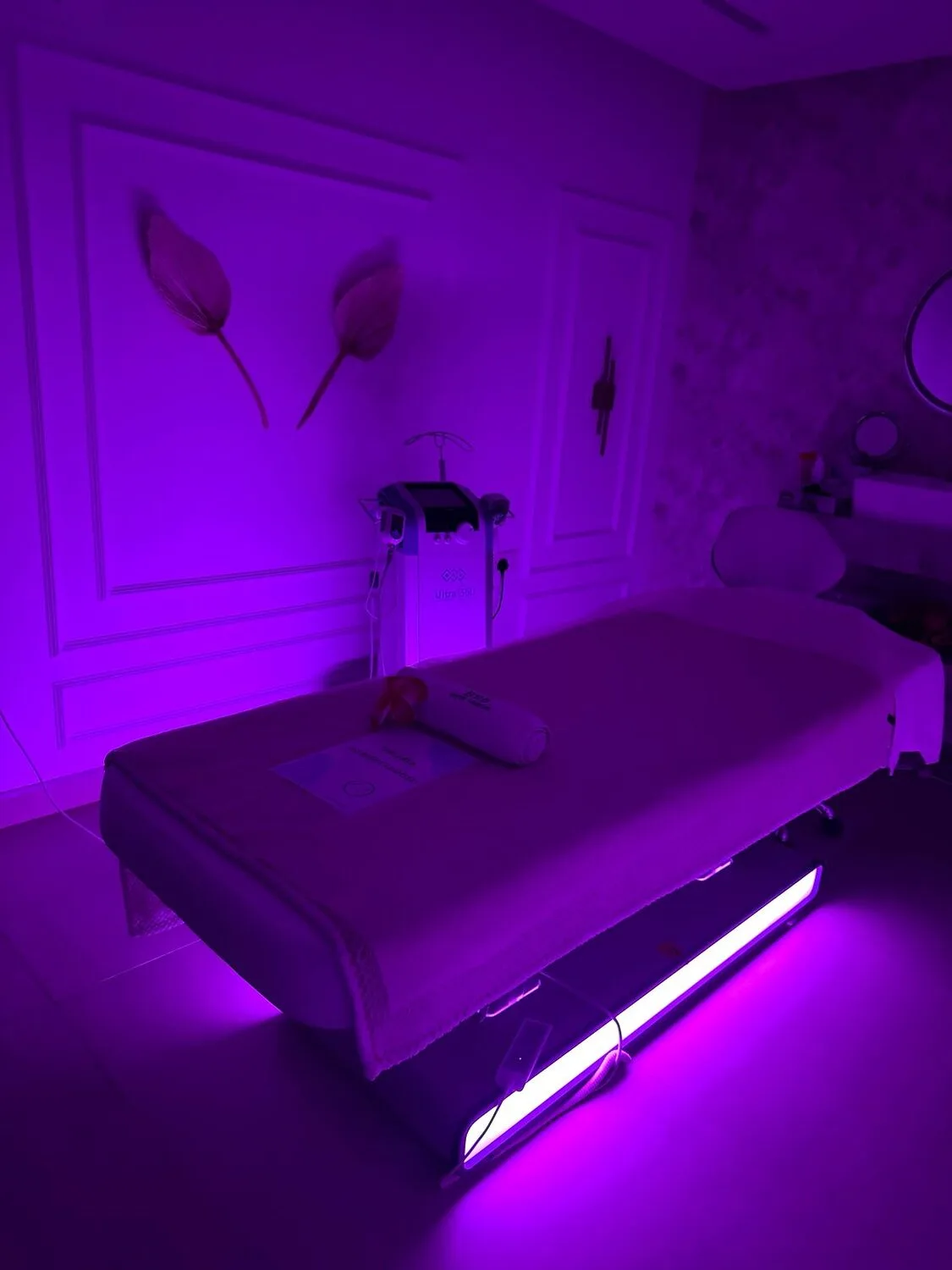
You lie in a quiet, private room at our studio in Azaiba. After cleansing and mapping the treatment zones, the therapist moves the MFU applicator across the area in lines — each pass delivering a row of focused pulses (the “shots” you’ll see in treatment names).
Honestly: it’s not a massage. Most guests describe waves of deep warmth with brief prickly moments over bony areas like the jaw. It’s entirely manageable, sessions run 25 to 60 minutes, and there’s no downtime — makeup and normal life resume immediately. Some guests notice a subtle immediate tightness; the real change arrives quietly over the following weeks.
What it costs at B28
MFU pricing scales with coverage — the number of shots and zones:
- Lower face (300 shots) — 25 minutes, 49 OMR: the focused entry point, centred on the jawline
- Face lift 400 shots + ULKIN hydration — 35 minutes, 79 OMR
- Face lift 600 shots + ULKIN hydration — 40 minutes, 99 OMR: the most complete single session
- Guided courses — e.g. three 500-shot sessions for 150 OMR, or monthly 300-shot maintenance programmes
Every technology treatment at B28 begins with a consultation and our free AI skin analysis — because the honest starting question isn’t “how many shots?” but “is MFU the right tool for your goal at all?” Sometimes the answer is a face-lifting massage or simple hydration first, and we’ll say so.
Who it suits — and who it doesn’t
MFU makes the most sense if you’re noticing early to moderate loosening — a jawline that’s softening, a brow that sits a touch lower, skin that feels less springy — and you want to support firmness without needles or downtime.
It is not the right tool if skin laxity is significant (that’s a surgical conversation, and pretending otherwise wastes your money), during pregnancy, or over areas with certain implants or conditions — all things we screen for in the consultation.
Our promise doesn’t change for technology: we’ll tell you what MFU can honestly achieve for your face, what it can’t, and whether something simpler would serve you better.
MFU, massage or both?
A question we hear weekly. The honest split: massage (including gua sha) works on tension and fluid — it refreshes and defines, session by session. MFU works on the collagen scaffold — slower, deeper, longer-lasting. They complement each other beautifully: many guests keep a monthly massage rhythm and add an MFU programme once or twice a year.
If you’re weighing the options, start with the free skin analysis and fifteen minutes of honest conversation. That costs nothing — and it’s the only way to know which path actually fits your face rather than the average face in an advert.